Why Outdoor Commercial Christmas Decorations Need Different Planning
Christmas decorations that work well inside a shopping mall do not automatically work the same way in a park, public plaza, pedestrian street, resort, or scenic attraction.
Outdoor projects involve longer viewing distances, larger installation areas, changing weather, different ground conditions, public access, and more complex electrical and structural requirements.
For giant Christmas trees, large light sculptures, entrance arches, reindeer, snowmen, Christmas balls, and walk-through tunnels, planning needs to start before production.
Material selection, scale, structural design, lighting, power distribution, transportation, installation, and future storage all affect how well the finished display performs.
Indoor decorations can place more emphasis on appearance and close-range detail.
Outdoor commercial Christmas decorations also need to address structural stability, weather exposure, fixing methods, electrical access, maintenance, and repeated seasonal use.
Outdoor Conditions Change Material Requirements
Outdoor Christmas decorations often remain installed and illuminated for several weeks.
During this period, products may be exposed to rain, moisture, low temperatures, sunlight, wind, and repeated temperature changes between day and night.
The metal frame, LED lighting, cables, connectors, and decorative surface materials all need to suit these conditions.
Large commercial light sculptures normally rely on an internal metal structure to maintain their shape.
For products intended for repeated seasonal use, corrosion protection becomes particularly important.
A hot-dip galvanized steel structure can reduce the risk of corrosion during repeated outdoor use, while outdoor LED strings and electrical connections need suitable protection against rain and moisture.
Surface materials need the same attention.
PVC tinsel, glitter fabric, acrylic decorative panels, mesh, and other finishes do not perform identically when exposed to rain, sunlight, repeated transport, and storage.
A commercial outdoor decoration should therefore be assessed from several angles:
- Nighttime lighting
- Daytime appearance
- Corrosion resistance
- Water protection
- Maintenance requirements
A Large Light Sculpture Is Also a Structural Product
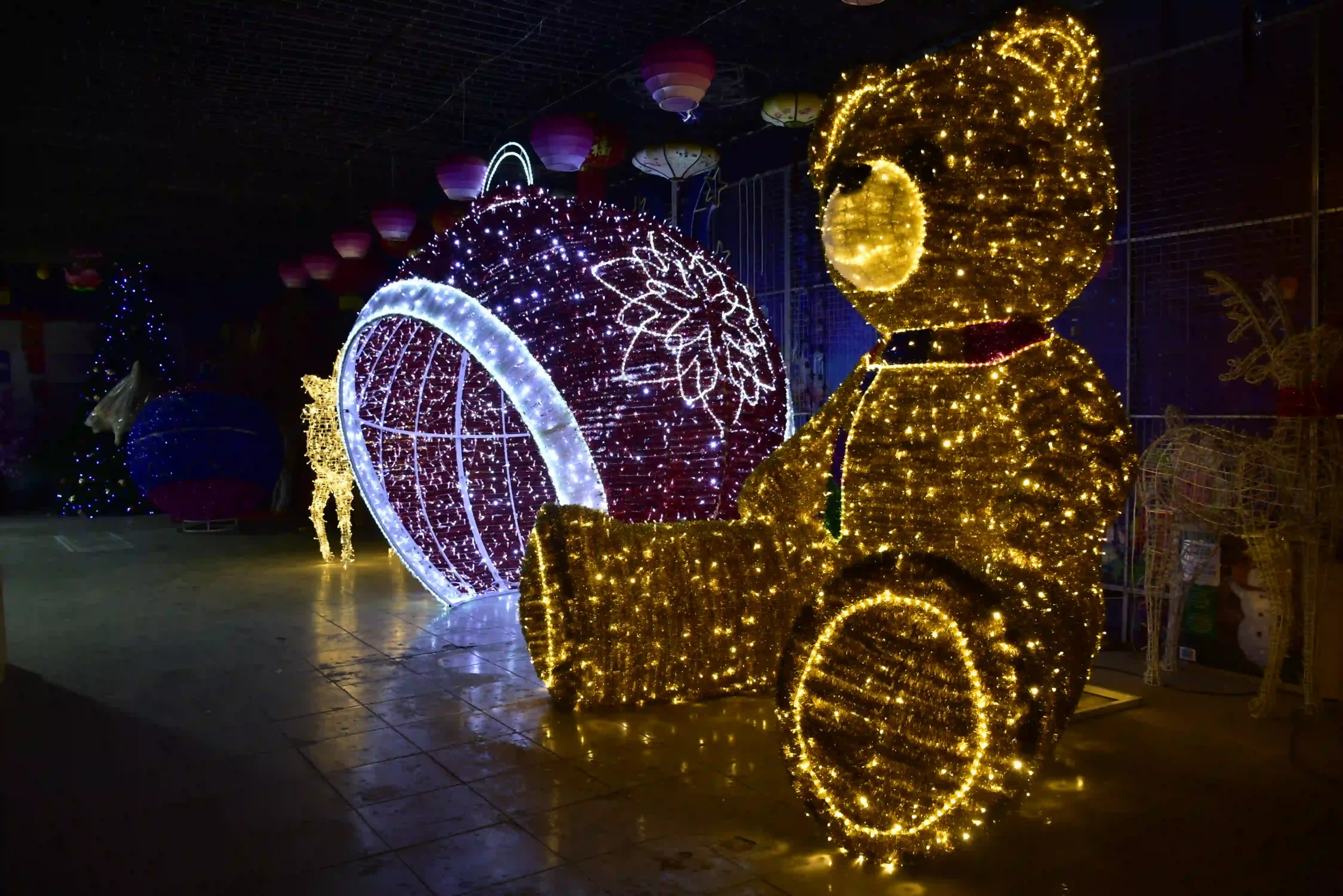
A 3-meter reindeer, 5-meter snowman, giant ornament, or walk-through Christmas arch is no longer a small seasonal decoration.
As overall dimensions increase, the center of gravity, base design, connection points, and narrow structural areas become more important.
Large reindeer have long legs and antlers that require adequate structural support.
Snowmen, Christmas trees, and spherical sculptures have larger bodies, so the frame must transfer weight correctly toward the base.
Walk-through arches and tunnels need to maintain both internal clearance and stable side supports.
Structural planning should therefore begin at the same time as visual design.
Before fabrication starts, the project should already define:
- Main frame
- Base structure
- Module connections
- Reinforced areas
- Installation method
- Transport divisions
Leaving these decisions until the sculpture is already finished often creates unnecessary installation problems.
Ground Conditions Affect the Fixing Method
The same light sculpture cannot always use the same fixing method on concrete, grass, soil, or temporary event flooring.
The installation surface should be confirmed before production.
Important site information includes:
- Ground type
- Product size and weight
- Wind exposure
- Installation duration
- Distance between visitors and the structure
- Whether drilling or anchor bolts are permitted
A sculpture installed on concrete may use base plates, anchor bolts, or another site-specific fixing system.
Grass and soil require different solutions depending on sculpture size, weight, and local conditions.
Some commercial venues do not permit permanent drilling, so the base design may need to be adjusted before production.
Walk-through products require additional planning.
Gift box arches, light tunnels, and walk-through Christmas balls have continuous visitor traffic through the structure. Base connections and fixing points therefore need to stay clear of the main walking area.
An open public square may also experience very different wind conditions from a courtyard surrounded by buildings.
Outdoor installation is not simply about making the sculpture stand upright.
The fixing system needs to keep it stable throughout the complete event period.
Outdoor Displays Need More Visual Scale
Indoor decorations are usually viewed from only a few meters away.
Smaller shapes, surface details, and subtle lighting changes remain easy to see.
Outdoor spaces work differently.
In a park entrance, city square, scenic attraction, or commercial district, the viewing distance may extend tens of meters.
A decoration that is too small can quickly disappear among buildings, trees, signs, traffic, and surrounding lighting.
Outdoor focal pieces therefore need clearer silhouettes and stronger scale.
A useful starting point is:
1–2 Meter Decorations
Suitable for pathways, supporting scenes, and close-range photo areas.
Around 3 Meters
Suitable for plaza displays, park nodes, and prominent areas near entrances. A 3M standing reindeer light sculpture is a typical example of this scale.
4–5 Meter Installations
Better suited to open lawns, large entrances, central plazas, and long-distance focal points. Products such as a 5M giant illuminated snowman remain much more visible in large open environments.
Repeated Arches and Tunnels
Useful for long walkways and routes with defined visitor circulation.
There is no single correct size for every project.
Brightness Cannot Replace the Correct Size and Position
A common response to a weak outdoor display is to add more lights.
The real problem may have nothing to do with LED quantity.
A one-meter decoration placed in the center of a very large plaza will still struggle to become a focal point, even if additional LEDs are added.
Changing the product size or installation position often produces a stronger result.
Large focal displays are usually most effective at:
- Main entrances
- Central plazas
- Route intersections
- Open lawns
- Long sightline endpoints
- Primary photo areas
Smaller decorations can then connect these major points.
This creates a clear visual hierarchy without forcing every decoration to compete for attention.
Public Spaces Need Room for Visitors and Maintenance
Commercial Christmas decorations are often installed in areas with heavy pedestrian traffic.
Parks, shopping centers, pedestrian streets, and theme parks may have large numbers of visitors approaching the displays throughout the day and evening.
Popular sculptures may also attract groups who stop for photographs.
The layout therefore needs more than enough space to physically place the decoration.
It should also account for:
- Visitor circulation
- Photo areas
- Cable routes
- Electrical connections
- Distribution boxes
- Maintenance access
- Emergency routes
- Required barriers or separation
Large structures should also allow technicians to reach important electrical areas.
A failed LED section or connector should be accessible without removing large decorative sections or dismantling the entire sculpture.
This is one of the practical advantages of modular structures and planned cable routing.
Electrical Planning Should Start Before Production
A commercial Christmas project rarely consists of one decoration.
The site may include a giant Christmas tree, entrance arches, street motifs, walk-through light tunnels, and multiple 3D sculptures.
Waiting until all products arrive before calculating electrical requirements creates unnecessary installation work.
The project should confirm early:
- Local voltage
- Number of products
- Power consumption of individual products
- Total power by zone
- Available power locations
- Distance between power and displays
- Cable routes
- Control method
- Plug standard
Large sites can also divide electrical distribution by area.
Central plaza
Walkway zone
Large sculpture zone
If one area develops an electrical problem, technicians can isolate that zone instead of turning off the entire display.
Electrical Connections Need to Remain Accessible
Outdoor holiday displays may operate every evening for several weeks.
Electrical planning therefore needs to go beyond making sure the products switch on successfully during installation.
Connectors, cables, controllers, and service points should remain accessible for inspection.
This is especially important for large sculptures.
If every connector is hidden deep inside an inaccessible section of a 5-meter structure, even a small maintenance issue becomes time-consuming.
Lighting circuits can be divided according to structural modules.
If one section develops a fault, technicians can identify the affected area more quickly.
Cables between modules should also be arranged so that connectors are not carrying unnecessary mechanical tension.
Where possible, site cabling should avoid crossing major visitor routes.
Large Decorations Need a Shipping Plan During Design
A finished sculpture measuring 4 or 5 meters high is rarely practical to ship as one complete unit.
Transportation needs to influence the structural design from the beginning.
Large decorations are normally divided into modules.
The design needs to define:
- Division points
- Maximum module dimensions
- Connection methods
- Electrical connections
- Module identification
- Packing dimensions
- Container loading
- Assembly sequence
A well-designed modular system can reduce shipping volume while making installation easier.
A poorly planned system may fit inside the container but become difficult to reassemble at the destination.
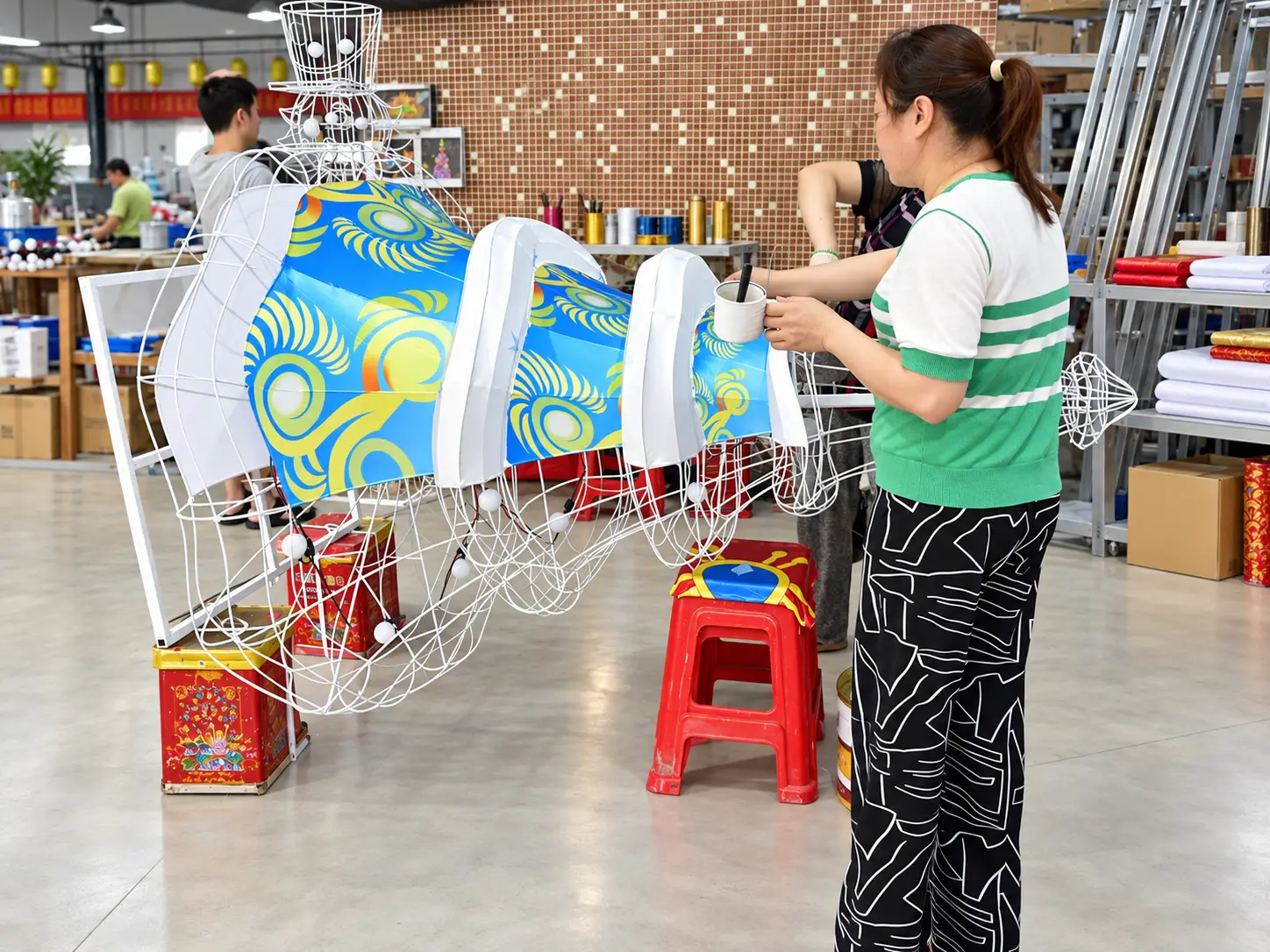
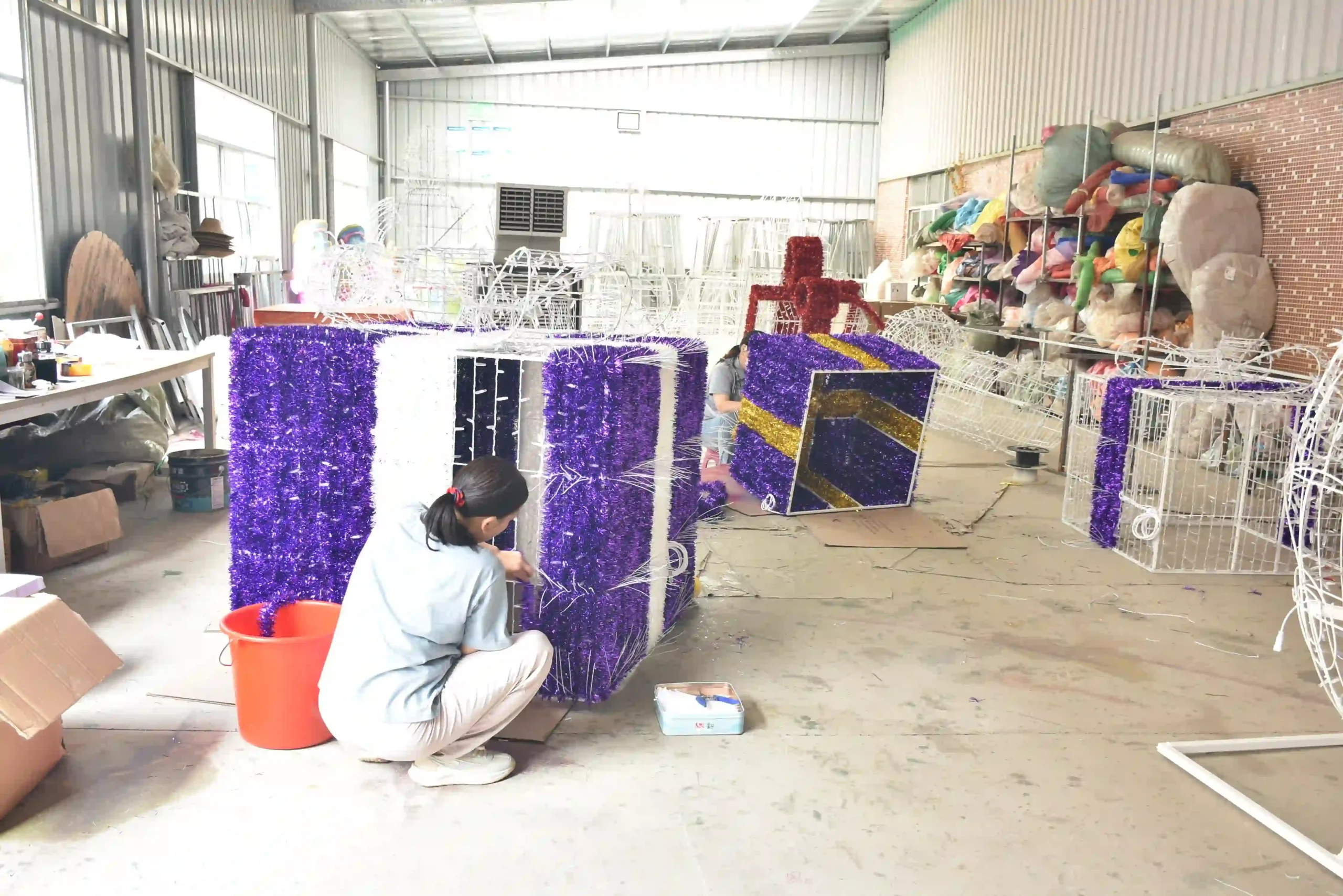
Large products should therefore be assembled and checked at the factory before packing.
After the shape, frame, connections, and lighting are confirmed, the structure can be divided into shipping sections.
For international projects, the custom Santa Claus light sculpture shipped to the USA shows how large decorative structures can move through frame fabrication, lighting assembly, inspection, protective packing, and container loading before delivery.
Packaging Affects the Condition of the Product on Arrival
Large Christmas light sculptures may combine steel frames, LED strings, electrical components, acrylic parts, fabric, tinsel, and decorative panels.
These materials do not face the same transport risks.
Irregular steel sections need protection against deformation.
LED strings and cables should not be compressed against sharp metal edges.
Acrylic and decorative panels need protection against scratches.
Tinsel and fabric finishes should not remain under heavy pressure for long periods.
Packaging should also consider future storage when products are expected to return for several seasons.
Reusable packaging can simplify dismantling, warehousing, and transport before the next installation.
Project Lead Time Is More Than Factory Production Time
The schedule for a large Christmas project cannot be based only on the number of production days.
A complete process normally includes:
Dimension confirmation
Structural drawing
Frame fabrication
LED installation
Surface finishing
Electrical testing
Factory trial assembly
Packing
International shipping
Customs clearance
On-site installation
Changes at any stage can affect the final installation date.
Outdoor installation is also exposed to weather conditions.
Heavy rain, strong winds, and other unsuitable conditions can delay work involving large structures or elevated installation.
Projects with fixed opening dates need additional schedule allowance for shipping, customs clearance, and installation.
Christmas events do not automatically move back one week because the products arrive one week late.
Plan for the Second Season During the First Purchase
Large commercial Christmas decorations are rarely intended for one season only.
Parks, shopping centers, theme parks, hotels, and municipal projects often expect to use their displays for several years.
The first purchase should therefore consider dismantling, storage, and future installation.
Important questions include:
- Can the modules be separated easily?
- Are sections clearly labeled?
- Can LED strings be replaced independently?
- Can connectors and hardware be stored safely?
- How will decorative surfaces be protected from compression?
- How will steel sections avoid scratching each other?
- Can the original packaging be reused?
These details directly affect installation time and maintenance costs in the following season.
Modular products can also be rearranged.
A reindeer group used near an entrance one year can move to the central plaza the next.
Individual arches can be installed separately or combined into a longer light tunnel.
Large Christmas balls, snowmen, and gift boxes can also be repositioned to create a different visitor route without replacing the complete decoration inventory.
Different Venues Need Different Outdoor Christmas Plans
There is no single commercial Christmas layout that works for every site.
Parks and Scenic Attractions
These locations normally have larger spaces and longer viewing distances.
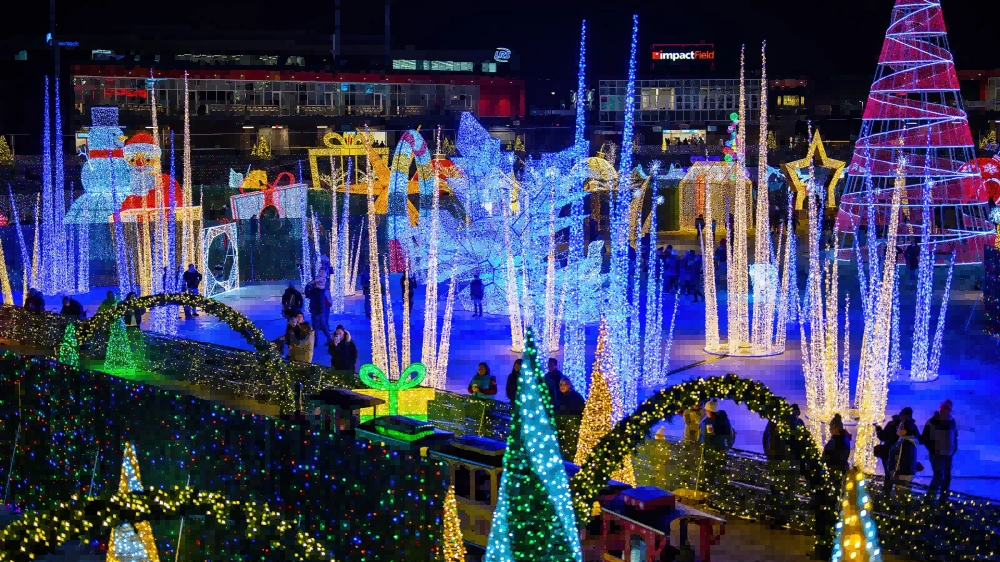
Large 3D light sculptures, animal groups, light tunnels, and giant Christmas trees can create multiple focal points along the route. A complete Christmas Wonderland park project can combine these different types of displays within the same visitor route.
Commercial Plazas
Visitors tend to gather in concentrated areas surrounded by large buildings.
Entrance arches, large Christmas ball lights, snowmen, gift boxes, and interactive photo displays work well as major visual features.
Shopping Mall Forecourts
The layout needs to account for entrances, vehicle circulation, pedestrian flow, storefronts, and building sightlines.
Decorations should remain visually strong without obstructing primary access routes.
Theme Parks
Scene continuity becomes more important.
Individual products should connect through theme, color, shape, and visitor flow rather than appearing as unrelated decorations.
Hotels and Resorts
Entrances, gardens, driveways, and building façades are often the key installation areas.
The number of major products may be smaller, but daytime appearance, surface finish, and the overall proportion of each focal piece become more important.
FAQ About Outdoor Commercial Christmas Decorations
What materials are suitable for outdoor commercial Christmas decorations?
Large outdoor projects normally require corrosion-resistant metal structures, outdoor-rated LED lighting and electrical components, and decorative materials selected for the expected weather and installation period.
How large should a commercial Christmas light sculpture be?
There is no universal size. The correct dimensions depend on the installation area, viewing distance, surrounding architecture, visitor volume, and the role of the sculpture within the overall project.
How are giant Christmas light sculptures shipped?
Large products several meters high are usually designed in modular sections. They are trial-assembled and tested at the factory, divided for packing, and reassembled at the project site.
Can the same fixing method be used on every surface?
No single fixing method suits every location. Concrete, grass, soil, and temporary event flooring have different installation conditions. Product dimensions, weight, wind exposure, and site restrictions need to be considered together.
How early should an outdoor Christmas project begin?
The schedule needs to include design, production, testing, packing, international transport, customs clearance, and on-site installation. Larger projects and projects with more custom products require an earlier start.
Can commercial Christmas light sculptures be reused?
Yes. A durable frame, modular structure, serviceable lighting system, and suitable packaging can allow large decorations to return for multiple seasons and be rearranged into different display layouts.
Outdoor Projects Should Be Designed from the Installation Site Backwards
Outdoor commercial Christmas decorations are not simply indoor decorations made larger.
Once the project moves outside, viewing distance, structural loads, weather exposure, electrical distribution, fixing methods, transportation, and maintenance all change.
Before production begins, a large light sculpture should already have clear answers to several questions:
- Where will it be installed?
- How far away will visitors see it?
- What size does the site require?
- How will it be fixed?
- How will it be powered?
- How will it be divided for shipping?
- How will it be assembled on site?
- How will it be dismantled and stored after the event?
The earlier these conditions are confirmed, the easier it becomes to keep design, manufacturing, shipping, and installation aligned.
HOLILITE develops large outdoor Christmas light sculptures, entrance installations, light tunnels, Christmas trees, character displays, and complete festive lighting solutions for parks, scenic attractions, shopping centers, commercial plazas, theme parks, hotels, resorts, and municipal holiday projects.
Products and structures can be developed around site dimensions, project drawings, reference images, local voltage, shipping requirements, and installation conditions.