PE vs PVC Christmas Trees: Which Is Better for Commercial Projects?
When buying a large artificial Christmas tree, you will often see three branch options: PVC, PE, and mixed PE + PVC.
All three are used for artificial Christmas trees, but they are manufactured differently and create different results in terms of realism, fullness, and project cost.
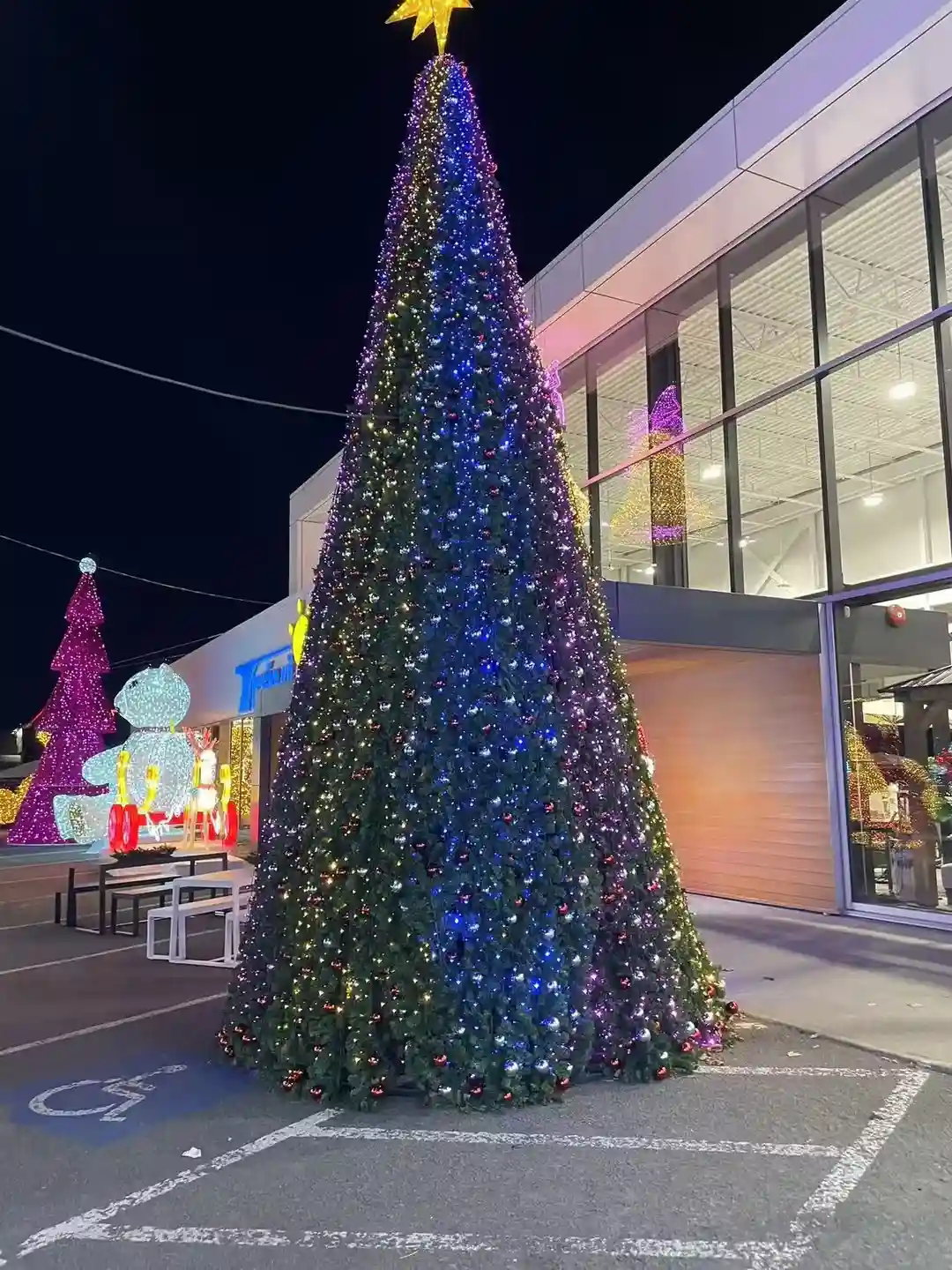
For a small indoor tree, the difference may mainly come down to appearance. For a commercial Christmas tree installed in a shopping mall, hotel, public plaza, theme park, or seasonal event, the decision becomes more important as the tree increases in size.

What Is a PVC Christmas Tree?
Flat-cut foliage designed to build volume efficiently.
PVC is one of the most commonly used materials for artificial Christmas tree branches.
Traditional PVC foliage is made from flat PVC film that is cut into narrow strips and attached to metal branch wires. Once the branches are opened and shaped, the material creates a dense and uniform needle effect.
The main advantage of PVC is not maximum botanical realism. Its strength is the ability to create a full-looking tree while keeping material costs manageable.
- Creates dense and full tree coverage
- Suitable for large quantities of foliage
- Relatively lightweight
- Cost-effective for large trees
- Works well with lights, ornaments, ribbons, and other decorations
This is why PVC remains widely used for large artificial Christmas trees installed in malls, outdoor plazas, commercial streets, parks, and public holiday events.
What Is a PE Christmas Tree?
Molded three-dimensional tips designed for more realistic branch detail.
PE branches are manufactured differently.
Instead of cutting flat plastic film into needles, PE branch tips are normally molded into three-dimensional shapes. This allows manufacturers to reproduce more of the form and texture found in natural pine, fir, or spruce branches.
- Hotel lobbies
- Premium shopping mall atriums
- Resort interiors
- Corporate reception areas
- Christmas photo zones
- High-end retail displays
Visitors in these environments may stand directly beside the tree, so branch texture becomes more noticeable.
PE branches, however, usually cost more to manufacture than traditional PVC foliage. On a small tree, this difference may be relatively easy to absorb. On a very large commercial tree requiring thousands of branch tips, using PE throughout the entire tree can increase the total project cost considerably.

What Is the Main Difference Between PE and PVC Christmas Trees?
If the comparison is based only on branch realism, PE normally has the advantage.
If the priority is building a large, dense Christmas tree while controlling overall cost, PVC is often more practical.
| Comparison | PVC | PE |
| Branch Structure | Flat-cut plastic needles | Three-dimensional molded tips |
| Close-Range Realism | Moderate | High |
| Creating Fullness | Very practical | Depends on branch quantity and design |
| Material Cost | Lower | Higher |
| Large Tree Cost Control | Better | More expensive at high quantities |
| Typical Viewing Distance | Medium to long distance | Close to medium distance |
| Typical Projects | Plazas, outdoor displays, events, commercial streets | Hotels, premium malls, lobbies, photo areas |
“Is PE better than PVC?”
“Where will the tree be installed, and how close will visitors be when they see it?”
Viewing Distance Changes the Material Decision
Viewing distance is particularly important for large commercial Christmas trees.
Large Plaza / Long-Distance Viewing
Consider a 10-meter tree installed in the center of a public plaza. Many visitors will see the tree from 10, 20, or even 30 meters away.
At that distance, the detailed texture of an individual branch becomes much less important.
For this type of project, using 100% PE may not always be the most effective way to allocate the decoration budget.
What visitors notice first
- Overall tree proportions
- Branch density
- Lighting density
- Christmas ball size
- Ribbon and snowflake placement
- Tree topper proportions
- Nighttime lighting effect
Close Viewing
The situation changes with a 4-meter or 5-meter tree installed in a hotel lobby or shopping mall, where visitors can walk directly beside the tree and take photographs.
Material Impact
At close viewing distances, realistic branch texture becomes much more noticeable, making a higher PE content more valuable.
For more detail on how branch material affects realism, see What Is the Most Realistic Looking Fake Christmas Tree?
Why Do Many Commercial Christmas Trees Use PE + PVC?
Large commercial Christmas trees do not have to be made entirely from one material.
For many projects, mixed PE + PVC branches provide a practical balance between realism, fullness, and cost.
PE Branch Tips
Improves realism in the parts of the tree that visitors see most clearly.
PVC Foliage
Builds internal volume and overall density without requiring PE throughout the entire tree.
A common configuration is to use PE branch tips in the more visible outer areas of the tree while using PVC foliage deeper inside the structure.
This configuration is particularly practical as tree height increases.
HOLILITE commercial Christmas trees can be customized with PVC, PE, or mixed PE/PVC branches according to the required appearance, tree size, installation location, and project budget.

Which Costs Less: PE or PVC?
PVC foliage generally costs less than molded PE branches.
However, branch material is only one part of the total cost of a commercial Christmas tree.
Same Height Does Not Mean Same Specification
Two 8-meter Christmas trees can have completely different prices.
One may use mainly PVC foliage with standard warm white LED strings and a basic ornament package. Another may use a high percentage of molded PE branches, oversized decorative balls, a custom illuminated star, and programmable RGB lighting.
The height is the same, but the specification is not.
This is why sending only “8m Christmas Tree” when requesting a quotation does not provide enough information for an accurate commercial proposal.
Shopping Malls and Hotels Need Different Specifications
Mixed Viewing Distances
A tree located in a shopping mall atrium may be viewed from very different distances. Visitors on the ground floor can walk close to the branches, while visitors on upper floors see the overall tree from farther away.
For this type of installation, PE + PVC is often a practical configuration.
PE can improve the appearance of the visible outer foliage, while PVC provides internal density and helps control the cost of a large tree.
If the tree is mainly designed as a long-distance visual centerpiece and will be heavily covered with lights, ribbons, Christmas balls, snowflakes, and other decorations, increasing the proportion of PVC may be more economical without significantly affecting the overall visual impact.
Close-Range Viewing
Hotel Christmas trees are often viewed at much closer distances.
Guests may walk past the branches, sit beside the tree, or use it as a background for photographs.
- PE branch percentage
- Outer branch detail
- Tree shape
- Foliage density
- Ornament quality
- Warm white lighting
- Daytime appearance when the lights are switched off
A higher PE percentage can therefore make more sense for premium hotel and resort installations.
That still does not mean the entire tree must automatically be made from PE.
Do Large Outdoor Christmas Trees Have to Use PVC?
No.
Large outdoor Christmas trees can use PVC, PE, or a combination of both.
For outdoor projects, however, branch material should not be evaluated in isolation.
Internal Steel Structure
The foliage must work with the structural system supporting the complete tree.
Modular Connections
Large commercial trees need sections that can be assembled and dismantled efficiently.
Base and Anchoring
The complete installation must suit the actual site conditions.
LED Lighting System
Lighting density and configuration contribute significantly to the final visual effect.
Electrical Configuration
The project must match the destination market and installation environment.
Transportation and Assembly
Packing volume, modular structure, transport, and installation are part of the complete specification.
On a large commercial tree, the foliage is only one part of the complete structure.
If you are planning a large project, the commercial Christmas tree buyer’s guide explains additional factors such as frame construction, lighting, customization, installation, and tree size.
PE, PVC, or PE + PVC: Which Should You Choose?
PVC
Choose PVC If:
- The tree is relatively large.
- Most visitors will view it from a medium or long distance.
- A full tree shape is more important than detailed needle realism.
- The project has a controlled budget.
- Lighting and large ornaments will provide most of the visual impact.
PE
Choose PE If:
- The tree will be viewed from close range.
- Realistic branch detail is a major design requirement.
- The project is located in a premium hotel, lobby, retail environment, or photo area.
- The project budget allows a higher-cost foliage specification.
PE + PVC
Choose PE + PVC If:
- You want better realism on the visible branches.
- You still need a dense and full tree structure.
- You want to control the overall cost of a large commercial tree.
- The tree will be viewed from both close and long distances.
For many large commercial projects, mixed PE + PVC offers the most flexible balance.
Do Not Choose a Commercial Christmas Tree by Branch Material Alone
PE and PVC matter, but they are only part of the specification.
Before ordering a large commercial Christmas tree, buyers should also confirm:
A commercial Christmas tree looks full, realistic, and visually balanced because all of these elements work together.
PE mainly improves visible branch detail. PVC helps create volume and control cost. The final appearance of the tree depends on how the foliage, tree shape, lighting, ornaments, and structural design are combined.
For shopping malls, hotels, public plazas, theme parks, and seasonal events, the right specification should therefore be based on tree size, viewing distance, project budget, installation environment, and the required finished appearance rather than choosing PE or PVC based on material name alone.