Who Is Sun Wukong? The Story of the Monkey King
Sun Wukong, also known as the Monkey King and the Great Sage Equal to Heaven, is one of the most recognizable characters in Chinese mythology and literature. Armed with the Ruyi Jingu Bang, he can travel through the clouds, transform his body, create copies of himself, and fight gods, demons, and supernatural creatures.
His story appears in Journey to the West, a Chinese novel written during the Ming dynasty. The book was inspired by the historical journey of the Buddhist monk Xuanzang, who traveled from China to India in search of sacred Buddhist texts.
In the novel, Sun Wukong becomes Xuanzang’s most powerful protector. His courage, intelligence, rebellious nature, and personal growth have made him one of the most popular mythological heroes in China.
Where Did Sun Wukong Come From?
Sun Wukong was not born from an ordinary monkey.
According to Journey to the West, a magical stone stood on Flower Fruit Mountain, absorbing energy from heaven and earth. Over time, the stone produced an egg-shaped object that transformed into a stone monkey when touched by the wind.
The stone monkey was intelligent, agile, and fearless. He soon joined the other monkeys living on the mountain.
One day, the monkeys discovered a waterfall and wondered what was hidden behind it. None of them dared to enter until the stone monkey volunteered.
He jumped through the waterfall and discovered a large cave called the Water Curtain Cave. The cave provided a safe and comfortable home for the entire monkey troop.
Because of his courage, the other monkeys declared him their king. From that moment, he became known as the Handsome Monkey King.
How Did Sun Wukong Gain His Powers?
Although he ruled Flower Fruit Mountain, Sun Wukong became troubled by the idea of aging and death. He left his kingdom and traveled across distant lands in search of immortality.
After years of wandering, he found a Taoist master named Patriarch Bodhi. The master accepted him as a student and gave him the name Sun Wukong.
Under Patriarch Bodhi, Sun Wukong learned martial arts, magical techniques, transformation skills, and methods of extending his life.
His most famous abilities included the Seventy-Two Transformations and the Cloud Somersault.
The Seventy-Two Transformations allowed him to change his appearance and body. He could become a human, animal, building, weapon, insect, or other object when escaping danger, gathering information, or fighting an enemy.
The Cloud Somersault allowed him to travel enormous distances with a single leap through the clouds.
The “seventy-two transformations” do not mean that Sun Wukong could only become seventy-two different animals. The phrase refers to a complete system of magical transformations.

What Is Sun Wukong’s Staff?
Sun Wukong’s most famous weapon is the Ruyi Jingu Bang, commonly translated as the Golden-Hooped Staff.
The staff originally belonged to the Dragon King of the Eastern Sea. It was kept in the underwater Dragon Palace and was once used as a magical pillar for measuring and controlling the depth of the sea.
The weapon was incredibly heavy, but Sun Wukong could lift and control it without difficulty.
The Ruyi Jingu Bang could also change its size according to his command. During battle, it could extend into an enormous weapon. When it was not being used, Sun Wukong could shrink it to the size of a needle and store it behind his ear.
Several visual features are strongly associated with Sun Wukong:
- A long golden staff
- A golden headband or decorated crown
- Red, yellow, and gold armor
- A monkey-like face
- A jumping or cloud-riding pose
- Sharp and alert eyes
- Decorative clouds, flames, or mountain elements
These characteristics make the Monkey King easy to recognize in paintings, sculptures, performances, films, and festival lantern displays.
Why Did Sun Wukong Fight Against Heaven?
After gaining extraordinary powers, Sun Wukong returned to Flower Fruit Mountain and established himself as a powerful ruler.
The Jade Emperor invited him to Heaven, hoping to control him by giving him an official position. However, Sun Wukong was appointed to a low-ranking role responsible for looking after the heavenly horses.
When he discovered how insignificant the position was, he became furious and returned to Flower Fruit Mountain. He then declared himself the Great Sage Equal to Heaven.
The heavenly authorities attempted to bring him under control, but the conflict continued to grow.
Sun Wukong entered the Peach Garden of Immortality and ate the sacred peaches prepared for a heavenly banquet. He also consumed magical pills from Laozi’s alchemy furnace.
These actions led to his famous rebellion against Heaven.
The Jade Emperor sent heavenly soldiers and generals to capture him, but Sun Wukong defeated many of them. Even powerful divine weapons and punishments failed to destroy him.
Eventually, the Buddha challenged Sun Wukong to escape from the palm of his hand. Sun Wukong believed he had traveled to the edge of the universe, only to discover that he had never left the Buddha’s palm.
The Buddha then imprisoned him beneath Five Elements Mountain.
Sun Wukong remained trapped there for five hundred years.
Why Did Sun Wukong Travel with Tang Sanzang?
Five hundred years after his imprisonment, Sun Wukong met Tang Sanzang, also known as the Tang Monk or Xuanzang.
Tang Sanzang was traveling west to obtain Buddhist scriptures. His journey required him to cross mountains, deserts, rivers, and regions filled with demons and supernatural dangers.
Sun Wukong agreed to protect the monk in exchange for his freedom.
He later traveled with two other disciples:
- Zhu Bajie, commonly known as Pigsy
- Sha Wujing, commonly known as Sandy
The four main travelers had very different personalities.
Tang Sanzang was compassionate and committed to Buddhist principles, but he frequently failed to recognize disguised demons.
Sun Wukong was intelligent, decisive, and highly skilled at detecting supernatural transformations.
Zhu Bajie was lazy, greedy, and easily distracted, although he could still provide valuable help during battles.
Sha Wujing was calm, dependable, and responsible for carrying the group’s luggage.
Sun Wukong frequently identified danger before the others, but his direct and aggressive actions often created conflict with Tang Sanzang.
To control him, Tang Sanzang used a magical headband placed around Sun Wukong’s head. When the monk recited the Tightening-Fillet Spell, the band caused intense pain.
During the journey, Sun Wukong gradually learned patience, responsibility, discipline, and compassion. After completing the pilgrimage, he received the title Victorious Fighting Buddha.

What Powers Does Sun Wukong Have?
Sun Wukong possesses a wide range of magical and physical abilities.
Seventy-Two Transformations
Sun Wukong can change his appearance, body structure, and size. He can transform into people, animals, insects, buildings, weapons, and other objects.
These transformations help him enter guarded locations, escape traps, deceive enemies, and gather information.
Cloud Somersault
The Cloud Somersault allows Sun Wukong to travel across vast distances at extraordinary speed.
It is often shown as a magical cloud carrying him through the sky.
Superhuman Strength
Sun Wukong possesses enormous physical strength. He can carry and control the Ruyi Jingu Bang, fight large monsters, and defeat powerful heavenly warriors.
Hair Clones
Sun Wukong can pull hairs from his body, blow on them, and transform them into copies of himself.
These clones can surround enemies, assist in battle, or complete different tasks at the same time. His hairs can also become weapons, animals, and other objects.
Fiery Eyes and Golden Pupils
After being placed inside Laozi’s alchemy furnace, Sun Wukong developed Fiery Eyes and Golden Pupils.
This ability allows him to recognize many demons and supernatural creatures, even when they disguise themselves as humans.
Immortality
Sun Wukong achieved several forms of immortality.
He learned longevity techniques, erased his name from the records of the underworld, ate the Peaches of Immortality, consumed heavenly wine, and swallowed Laozi’s magical pills.
These experiences made him extremely difficult to kill.
Size-Changing Weapon
The Ruyi Jingu Bang can become longer, shorter, thicker, thinner, heavier, or smaller according to Sun Wukong’s needs.
He often combines the staff with his transformations, speed, clones, and physical strength during battle.
What Does Sun Wukong Symbolize?
Sun Wukong represents several different ideas.
He is brave, intelligent, independent, and unwilling to accept unfair treatment. His rebellion against Heaven reflects his resistance to authority and his desire for freedom.
At the same time, he can be impatient, proud, aggressive, and difficult to control.
His journey with Tang Sanzang gradually changes him. He learns to use his power to protect others rather than simply proving his own strength.
Sun Wukong is therefore often associated with:
- Courage
- Freedom
- Intelligence
- Resistance
- Loyalty
- Self-discipline
- Personal growth
- Protection against evil
One of the most important parts of his story is the contrast between power and responsibility.
Sun Wukong begins as a rebellious figure who believes strength allows him to ignore every rule. Through the journey, he learns that true strength also requires patience, judgment, and responsibility.
This development transforms him from a troublemaker who challenged Heaven into a hero capable of completing a sacred mission.
Sun Wukong in Modern Culture
Sun Wukong has appeared in Chinese opera, paintings, sculptures, novels, animation, television series, films, stage performances, comics, and video games.
As Journey to the West spread beyond China, the Monkey King became increasingly familiar to international audiences.
Different adaptations may change his armor, facial features, personality, or fighting style. However, most versions retain several important visual elements:
- The golden staff
- The monkey-like face
- The magical headband
- The cloud-riding pose
- The red and gold costume
- The rebellious and confident personality
Modern films, animated productions, and video games continue to introduce Sun Wukong to new generations of audiences.
Sun Wukong as a Festival Lantern
Sun Wukong’s distinctive appearance and dramatic movements make him well suited to large festival lantern displays.
A Monkey King lantern can present him in several recognizable forms:
- Swinging the Ruyi Jingu Bang
- Riding or jumping from a magical cloud
- Wearing the armor of the Great Sage Equal to Heaven
- Standing in front of Flower Fruit Mountain
- Fighting heavenly soldiers or supernatural creatures
- Leading the other characters from Journey to the West
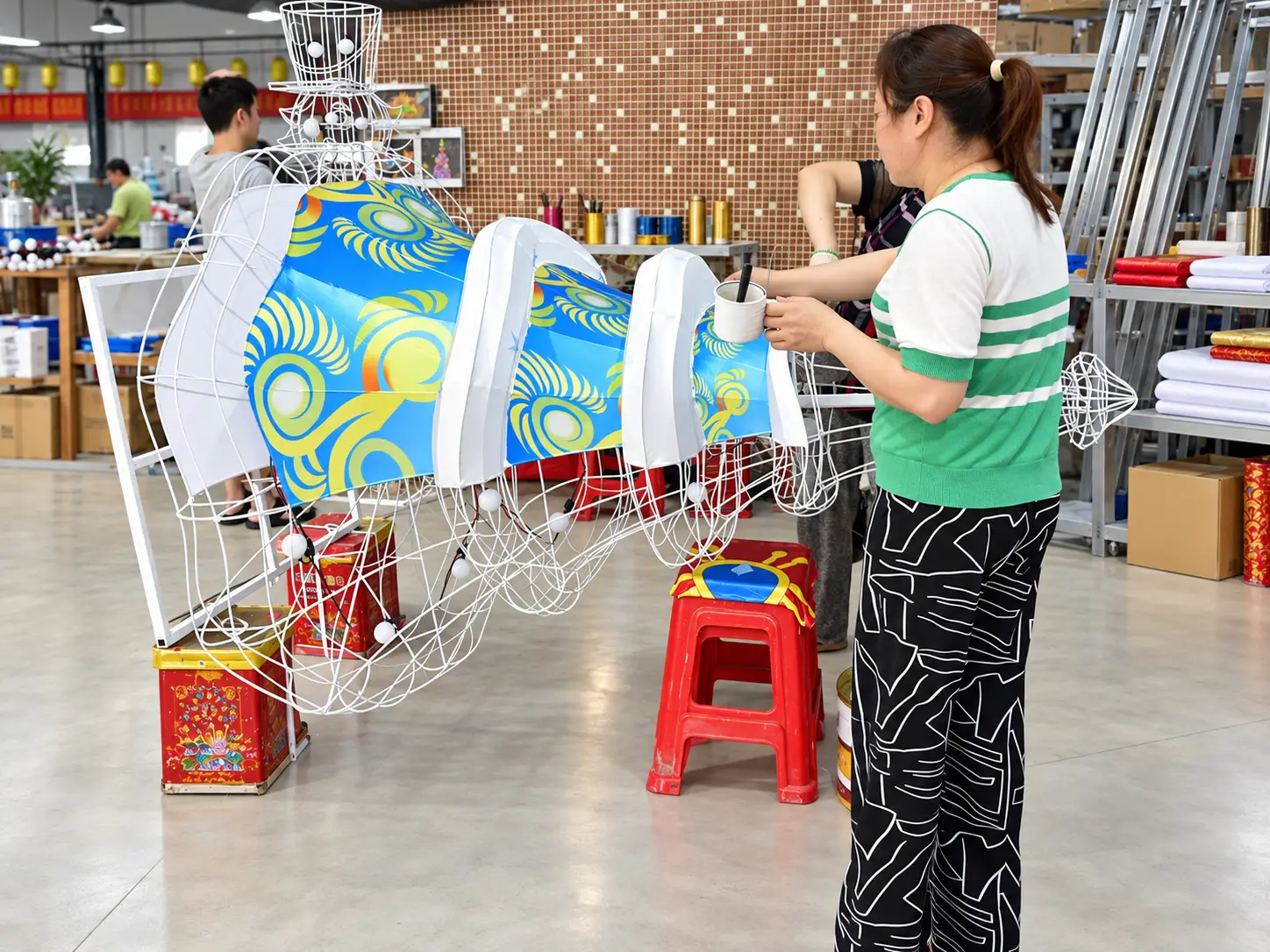
A large Sun Wukong lantern normally requires a reinforced internal metal frame to support the body, staff, arms, costume, and extended decorative elements.
The frame is covered with colored translucent fabric, while LED lighting is installed inside the structure. The internal lights illuminate the face, armor, clothing, clouds, flames, and background elements.
The Monkey King Lantern from Holilite can be customized in size, pose, color, lighting arrangement, and scene composition.
The structure can include:
- A steel or aluminum internal frame
- Flame-retardant translucent fabric
- Waterproof LED lighting
- Modular sections for transportation
- Replaceable lighting and electrical components
- Customized voltage and power connections
- Static or programmed lighting effects
Large Monkey King lanterns are suitable for lantern festivals, cultural events, theme parks, scenic areas, night tours, shopping centers, and public holiday displays.
Creating a Journey to the West Lantern Display
A single Monkey King sculpture can serve as a recognizable photo attraction. A larger project can present several scenes from Journey to the West along a visitor route.
Possible themes include:
- Flower Fruit Mountain
- The Water Curtain Cave
- The Dragon Palace
- Havoc in Heaven
- Five Elements Mountain
- The Flaming Mountains
- The Kingdom of Women
- The White Bone Demon
- The Spider Demons
- The full pilgrimage team
The project can begin with Sun Wukong’s birth from the magical stone and continue through his training, rebellion, imprisonment, and journey with Tang Sanzang.
This approach turns an individual lantern sculpture into a complete cultural and storytelling experience.
Frequently Asked Questions
Is Sun Wukong a God?
Sun Wukong began as a stone monkey and later gained supernatural powers through training and several forms of immortality.
He declared himself the Great Sage Equal to Heaven and was eventually granted the title Victorious Fighting Buddha after completing the journey.
He can therefore be understood as a literary character, mythological hero, supernatural being, and religious figure.
Why Is Sun Wukong Called the Monkey King?
Sun Wukong entered the waterfall on Flower Fruit Mountain and discovered the Water Curtain Cave.
Because he found a safe home for the monkey troop, the other monkeys declared him their king. This is how he became known as the Handsome Monkey King.
What Is Sun Wukong’s Staff Called?
His weapon is called the Ruyi Jingu Bang, commonly translated as the Golden-Hooped Staff.
It can change its size and is normally stored behind Sun Wukong’s ear when not in use.
Can Sun Wukong Transform into 72 Animals?
No. The Seventy-Two Transformations do not refer to seventy-two specific animals.
They describe a system of magical transformations that allows Sun Wukong to become humans, animals, insects, objects, buildings, and other forms.
Who Defeated Sun Wukong?
Heaven’s soldiers and generals failed to permanently defeat Sun Wukong.
The Buddha eventually trapped him beneath Five Elements Mountain. He remained there for five hundred years before being released to protect Tang Sanzang.
Who Are Sun Wukong’s Companions?
His main companions are Tang Sanzang, Zhu Bajie, and Sha Wujing.
Together, they travel west in search of Buddhist scriptures while overcoming demons, monsters, and supernatural obstacles.
What Does Sun Wukong Represent?
Sun Wukong commonly represents courage, freedom, intelligence, resistance, loyalty, and personal growth.
His story also explores how great power must be guided by discipline and responsibility.