What Is the Prettiest Type of Christmas Tree? Lighting Guide
When people ask “What is the prettiest type of Christmas tree?”, the answer is not limited to choosing between a real or artificial tree. The final appearance depends on shape, branch structure, symmetry, needle texture, ornaments, and especially the way the tree is illuminated.
From a professional Christmas lighting perspective, the prettiest tree is usually the one that combines a balanced form with lighting that creates depth, warmth, and visual consistency.
Does Tree Type Really Determine Beauty?
Tree type has a clear influence on appearance, but it is only one part of the complete design.
A Christmas tree’s visual effect is influenced by:
- Branch density and spacing
- Overall shape and symmetry
- Needle color and texture
- Ornament size and distribution
- Lighting density
- How the lights interact with the branches
A premium tree can still look flat at night if the lighting is uneven or leaves large dark areas.
Popular Christmas Tree Types and Their Visual Effect
Fir Trees
Fir trees are a popular Christmas choice because of their balanced conical shape and sturdy branches. Warm white or soft golden lighting works especially well with this form, creating a classic and elegant appearance.
Spruce Trees
Spruce trees have a more natural and slightly irregular branch structure. Dense string lighting can fill the spaces between branches and create a traditional Christmas atmosphere.
Pine Trees
Pine trees have longer needles and more open branches. The additional spacing makes the lights more visible, which works well when brightness and sparkling points are an important part of the design.
Artificial vs. Real Trees: Which Looks Prettier?
In large commercial displays, artificial Christmas trees are commonly selected because their shape and branch arrangement can be controlled during production.
- Consistent overall shape
- Controlled branch density
- Even spacing for lights and ornaments
- Repeatable appearance across multiple seasons
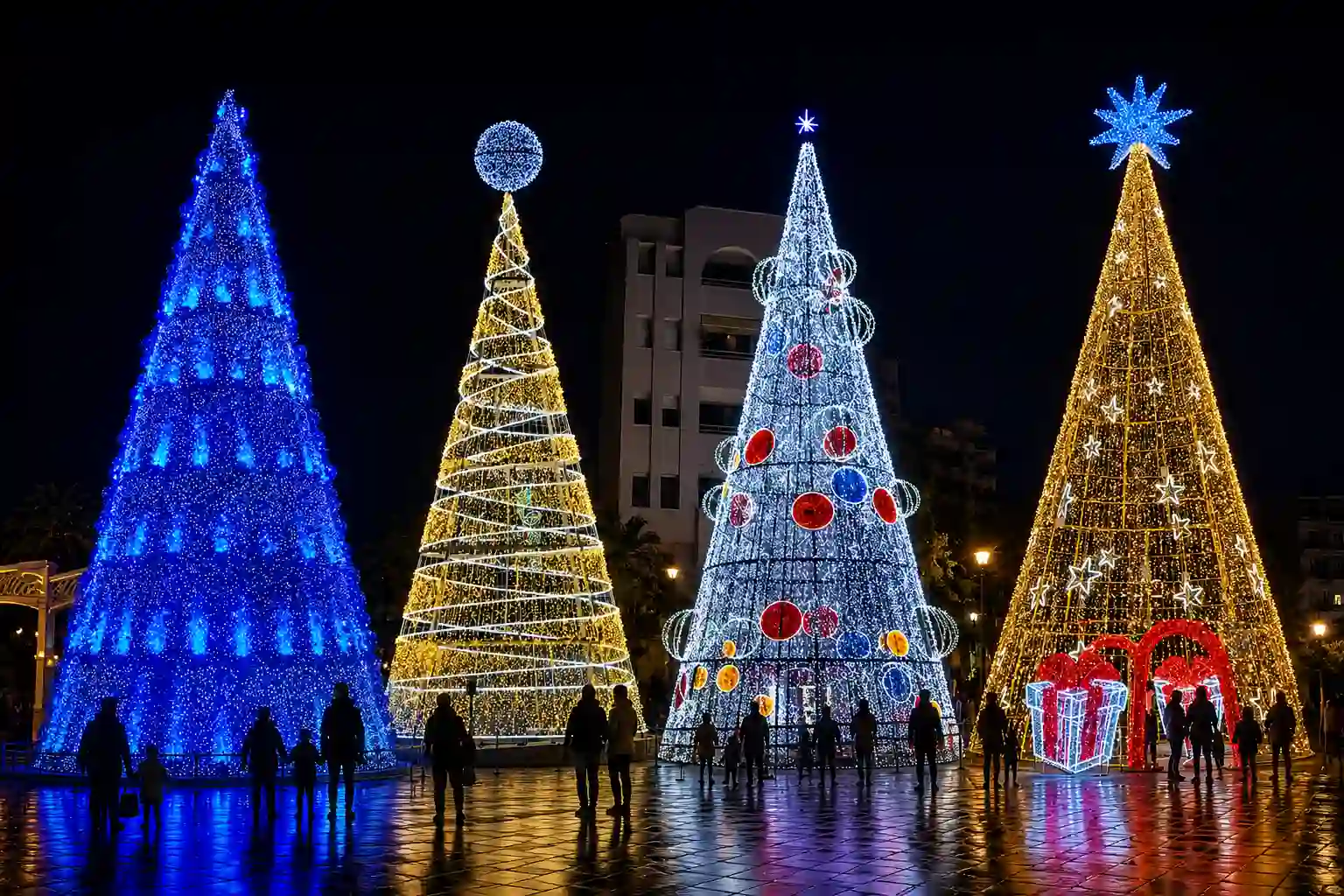
This makes artificial trees practical for shopping centers, city squares, hotels, theme parks, and other large-scale Christmas projects where symmetry and lighting consistency matter.


Why Christmas Tree Lighting Matters
Lighting can dramatically change the appearance of the same Christmas tree. The number of lights, spacing, color, direction, and brightness all affect how the branches and overall silhouette are perceived after dark.
Well-planned Christmas tree lighting can:
- Add depth and dimension
- Highlight the shape of the tree
- Reduce dark gaps between branches
- Create a warmer nighttime appearance
- Emphasize ornaments and structural details
- Turn a large tree into a visible nighttime landmark


What Makes a Christmas Tree Look Beautiful at Night?
Nighttime appearance depends on how evenly the tree is illuminated from the top to the lower branches.
- Even light distribution from top to bottom
- Suitable spacing to avoid dark gaps
- Lighting density matched to tree size
- Appropriate color temperature for the environment
- Consistent brightness across the complete tree
- Stable lighting performance during the display period
Professional Christmas tree lighting systems can be planned around the tree height, diameter, branch structure, and desired nighttime effect.
What Is the Prettiest Christmas Tree?
For decorative and commercial projects, there is no single tree species or style that is always the prettiest.
Fir trees offer a classic balanced shape, spruce trees provide a more natural appearance, and pine trees expose more of the lighting between their branches. Artificial trees provide greater control over symmetry, branch spacing, lighting positions, and repeatable appearance.
The strongest visual result comes from matching the tree structure with the right lighting density, color, ornaments, and scale.
Frequently Asked Questions
What type of Christmas tree looks best with lights?
Trees with balanced branch spacing work particularly well because the lighting can be distributed throughout the structure without creating large dark areas.
Are artificial Christmas trees prettier than real ones?
Both can look attractive. Artificial trees provide more control over shape, symmetry, branch spacing, and lighting, which is useful for large commercial displays.
What color lights make a Christmas tree look prettiest?
Warm white and soft golden lighting are popular for an elegant traditional appearance, while RGB and colored lighting are suitable for more dynamic contemporary displays.
Do more lights make a Christmas tree prettier?
Not automatically. Even distribution and suitable density are more important than simply increasing the total number of lights.