Christmas Lighting: A Short Overview
Christmas lighting has moved far beyond a few candles on a tree. It is now one of the clearest visual languages of the holiday season. Trees, ornaments, snowflakes, sleighs, gift boxes and character lights help people recognize a Christmas scene at first sight.
In outdoor spaces, holiday lights do more than add brightness. They define entrances, guide visitors, create photo spots and connect different decorations into one complete display. Parks, shopping malls, plazas, hotels and event venues all use lighting to turn open areas into festive destinations.
From candlelight to modern LED displays. Early Christmas lighting was quiet and symbolic. Candles created a warm glow around trees and indoor celebrations. Electric light strings later replaced candles and made Christmas decoration safer, brighter and easier to scale. Modern LED holiday lights changed the scene again. Large frames, programmable controllers, dense LED strings and modular structures allow designers to build outdoor displays with stronger shapes and clearer themes.

Artificial Outdoor Lighted Trees
Artificial outdoor lighted trees create height and structure in a holiday display. Their illuminated branches can fill a lobby, garden, plaza or entrance area without relying on natural trees. They work well around larger Christmas scenes, behind photo areas, beside walkways, or near shopping mall and hotel entrances.

Santa’s Sleigh Decorations
Santa’s sleigh decorations are strong narrative pieces. A lit sleigh with reindeer figures gives the scene a clear Christmas story and attracts families, children and photo-taking visitors. It can be placed near a large Christmas tree, at the end of a light tunnel, beside a plaza entrance or inside a mall atrium.

Outdoor Light Snowflake
Outdoor light snowflakes are useful for rhythm and repetition. Their geometric shape is easy to recognize and works well in winter-themed Christmas displays. Snowflake lights can be placed along walkways, above entrances, across open plazas or beside larger installations.

Lighted Teddy Bear
A lighted teddy bear brings a softer and more family-friendly feeling to the holiday scene. It is suitable for children’s areas, indoor atriums, hotel lobbies, shopping malls and festive photo corners. Character lights make a display easier to connect with emotionally.

Gift Christmas Boxes
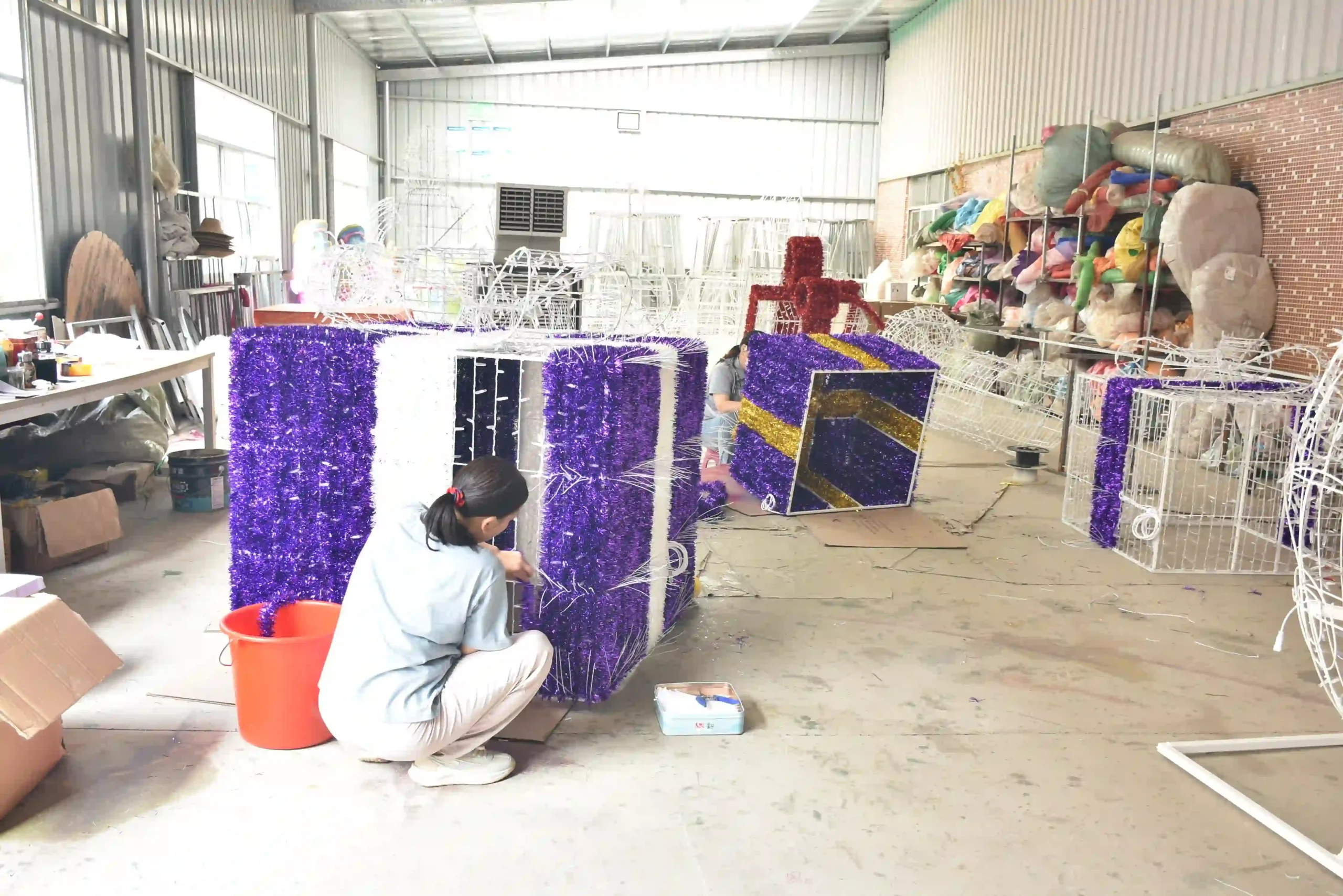
Gift Christmas boxes add layers and depth to a holiday display. They can be arranged around a tree, placed near Santa’s sleigh, lined along a pathway or used as foreground decorations in a photo area. Large gift boxes fill open space. Medium boxes support the main display. Small boxes decorate corners, tree bases and visitor routes.
Building a Complete Christmas Display
A complete Christmas display should have a clear visual order. The main element needs to be visible first. Supporting decorations should guide the eye toward it. Smaller lights should fill the route without making the scene crowded.
An outdoor plaza may use a large lighted tree as the central feature, snowflakes as repeated background elements, a Santa sleigh as the photo point, teddy bears for family appeal and gift boxes to complete the foreground. When holiday lights are arranged as a scene, they guide movement, create memories, support photo sharing and make public spaces feel warmer during the Christmas season.